Saturday, May 18, 2013
New York
Thursday, April 18, 2013
Sunday, June 10, 2007
The following day i maintained my role as selfproclaimed mr zeitgeist by catching the hoxton square half of the Damien Hirst exhib - he is very opportunistic but good to see continuations on his earlier themes. The guy in the fluffy dog costume hat streaking across Hoxton Square afterwards was pretty funny too.
Thursday, May 31, 2007
It's a cool job - a staunch, yet vigorously welcomed, contrast to the rarified cloisters of bucolic academia up the M11, or indeed down Anzac Parade. It's mainly about Excel, which i incorrectly thought i had some idea about how to use in late March.
Other news, in increasing order of importance:
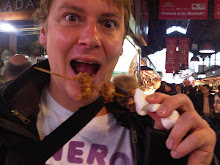
Went back to Sydney (again, for three days this time, ouch) and gave a speech. If you thought the pic above was pretty silly, try this on for size. As an added bonus, i got to see Vero distinguish themselves for probably the last time in the BRW triathlon :
Loving London life: the buzziness, the morning rush, feeling like you're right in thick of it, sunny afternoon beers outside City pubs, hunting out trendy art galleries in dodgy industrial estates, the laaate night bottleshops, the mix & unpredictability. Back into running so have been exploring the burbs round us; haven't mastered commuting, or indeed "routines", yet so have been exploring the train, tube and bus timetables from 7:20 to 10:30 am.
Living in Souwf Lundun with these champs:
They're talking on the "telephone" to the "magical aliens" orbiting the "moon". They like to do that sometimes. I do too.
.
Thursday, March 01, 2007
Only just online today, here's the latest (and best, I opine) installment in the Tate Tracks series of musical pieces created for and inspired by artworks at Tate Modern: Union of Knives "Four Seasons" after Cy Twombly's Quattro Stagioni
Have a listen.
Wednesday, February 14, 2007
I'm writing this one from the BA lounge at Heathrow - in a far more salubrious, i.e. sober and not sunburnt, state than my last outgoing flight from here - with an hour to kill before my flight. Normally this would be spent reading the economist amongst the hoi palloi and eating some crisps. But not this time - i'm now reading the economist amongst the club world travellers and eating sandwiches - complimentary ones - and drinking wine. Coogee, Darlinghurst and Newtown, here i come - this time in some degree of style. See yer soon!
Friday, February 02, 2007
I've been doing a bit of reading, me. So here goes with the opinionation (in generally increasing order of relevance and topicality) on a particularly interesting, and undeniably important, topic:
1. Niall Ferguson "The Cash Nexus" - a very ambitious topic for a history, but he's a very enterprising fellow and threw himself right into this one, during his year as a research fellow at the Bank of England - how appropriately fascinating that such a programme can induce such a suitably venerable yet scholastically auspicious survey - a must-read for anyone who consideres themselves interested, or even slightly capable, in the inarguably pivotal world of capital and capital transfer.
2. John Perkins "Confessions of an Economic Hitman" - i have a confession of my own: i first heard of this in the text of a voice sample in a mash-up breaks track called Alex Stealthy: As a Child vs. DemocracyNOW! feat. John Perkins: Economic Hitman as follows:
"Economic hitman - explain:"
"We identify a third world country that has resources which we covet, and often these days that's oil, or it might be a canal in the case of Panama. In any case, we go to that third world country and we arrange a huge loan from the international lending community, usually the World Bank usually leads that process. So let's say we give this third world country a loan of a billion dollars, one of the conditions of that loan is that the majority of it, roughly 90% comes back tothe United States, to one of our big corporations, the ones we've all heard of recently, the Bechtels, the Halliburtons.
"And those corporations build, in this third world country, large power plants, highways, ports, or industrial parks, big infrastructure projects that basically serve the very rich in those countries. The poor people in those countries and the middle class suffer, they don't benefit from these loans, they don't benefit from the projects, and in fact, often their social serviceshave to be severely curtailed in the process of paying off the debt.
"Now what also happens is that this third world country then is saddled with a huge debt that it can't possibly repay. For example today, Ecuador's foreign debt as a result of economic hitman is equal to roughly 50% of its national budget. It cannot possibly repay this debt. It's the case with so many third world countries. So now we go back to those countries and say"look, you borrowed all this money from us and you owe us this money you can't repay your debts, so give our oil companies your oil at very cheap cost"
"And in the case of many of these countries, Ecuador is another good example here, that means destroying their rainforests, destroying their indigenous cultures. And that's what we're doing today and we've been doing it... it began shortly after the end of World War II, it's been building up over time, until today it's really reached mammoth proportions where we control most of the resources of the world."
A bit of googling and a trip to Borders and I'd read the book - his interview above pretty much sums it up - the book is pretty light on detail but interesting to get an insiders perspective
3. Thomas Friedman "The World is Flat" - this had been sitting in my desk drawer at work for a while waiting for the time.
4. Joseph Stiglitz "Globalization and its discontents" - my learned colleague G. Turner of previous recent Manchester kebab blog reference had lent me the successor to this work, "The Roaring 90s", not long after that one was published. At the time I found it fascinating, very well explained and significantly topical, even for a materials scientist in the midst of thesis-writing self-absorption. Since then i've become consistently more interested in such issues, so i was looking fwd to catching up on Stiglitz' earlier work on globalisation. His most recent popular work "Making Globalization Work" had also hit the shelves. Stiglitz was the chief economist at the World Bank