Sunday, February 26, 2006

London 9

The ninth and latest installment in Matthew's Trips to London was brief yet action-packed, motivated by an overwhelming desire to make the most of my life before it slips away from me, day by precious day. After a quick morning meeting at the office - yeah, that's right, on a Saturday, pretty dedicated, aren't I? - i jumped on the train and made a beeline for the British Museum. It, along with the V+A, is one of my few as-yet-unrealised touristic aims in London, and i felt the situation ought to be redressed.

Unfortunately in my excitement to get into the office for a meeting, i neglected to pack my camera, so I will have to resort to long, tedious descriptions of everything I saw (along with copywright-infringing images from other people's websites) in order to properly document my activities for the day. Here's a photo i prepared earlier when i walked past the museum one time.
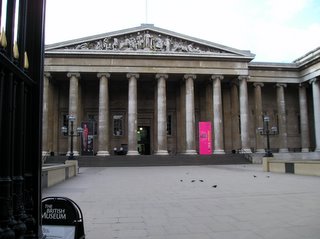
It was closed then, but fortuitously open when i went this time; the empty forecourt pictured was in fact teeming with tourists. The British Museum, as many will know, has an incredibly profilic collection so that one would struggle to see all the pieces on display (a small subset of the total collection) in one visit. I did the obligatory ones: the Rosetta Stone, the Egyptian mummies and the Elgin (Parthenon) marbles. The last of these is a great source of controversy as Greece feels that they should be returned. Several arguments against this are usually given: the artifacts have been looked after better at BM (though there are claims that this isn't necessarily the case), that it is better to present these works alongside others from other cultures, etc. Furthermore, the BM itself states ,"the restitutionist premise, that whatever was made in a country must return to an original geographical site, would empty both the British Museum and the other great museums of the world". The marbles are nice but they are not nearly as spectacular (and accordingly represent a less significant act of looting) as, for example, the Zeus Altar taken from Pergamon in Turkey to Berlin in the 1880s, which is also a source of contention.

For my two cents worth: Sorry but bad luck. Greece wasn't even a country when Lord Elgin took the marbles. The Ottomans, who were in power there at the time (until Britain, France and Russia stepped in to help Greece gain independence), were happy to let them go. Empires have looted each other like crazy for millenia, taking whatever they could get their hands on. Just as the Pergamon Altar and the museums built in Berlin to accomodate it and other such artifacts became a monument to Prussian then German nationalism, the Pergamon marbles have been in, and become a part of, Britain for two centuries. At what point in history should the line be drawn between actions that are part of history and cannot be reversed, and those which should be reversed ie. revised?

Controversy aside, my favourites at the British Museum were the Assyrian gates, the marbles from Halicarnassus, the Andean costumes in the special exhibition on Living and Dying and the Enlightenment exhibition. Definitely worth a return visit.

Having done the ancient thing, i went to get a bit of the modern, at the Dan Flavin retrospective at the Hayward Gallery.

Went to the Tate Modern to make the most of my membership by sitting in the Member's Room, drinking lattes, eating olives and feeling really special and exclusive. Also had a look at the Martin Kippenberger exhibition but was flagging by this stage so will have to go back again before i can make any judgements. Wandered through the main collection and sat through a film by Markus Schinwald entitled dictio pii that, despite the haunting ambient soundtrack music that i really liked, was a touch disturbing, especially once the narrated monologue ("We are the perfume of corridors, unfamiliarized with isolated activity, ... blahblahblah for another two and a half minutes,... tortured geometries, unsyncopated energies, blahblah... , we are deranged") had been repeated five times. Remarkably spooky characters.

Back to Cam for a few quiet ones and called it a day. A busy and tiring yet ultimately satisfying day.

Thursday, February 16, 2006

London & Bristol

Scurried down to London for Kylie's birthday party on a Friday night.
Met up with the lovely MJ and the lovely Paul and headed to Clapham for a bit of the usual shenanigans, spurred on by cachaça warm-up rounds at MJs:


Here's the birthday girl:

Home via Chicken Cottage (Clapham Brick Lane curry for me):

____________________________________________________________

Up bright and early the following morning, had the remainder of the curry for breakfast and hit the road. We diverged at Victoria: MJ south to Brighton and I west to Bristol - twas a teary farewell I assure thee.

No sooner than i'd finished the Review section of the Guardian, i arrived at Bristol Temple Meads, then bussed into town. After some confusion related in part to Tim's unfamiliarity with his adopted home city and in bigger part to my general incompetence regarding public transport, maps, directions and instructions, we were eventually united. Joyfully so.


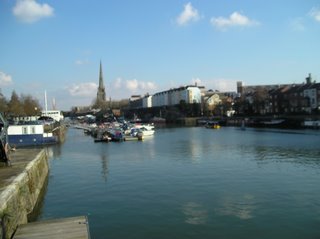
Had a look around the waterfront and the Arnolfini, a contemporary art space on the docks.

Up the hill to the City Museum & Art Gallery

There was a touring exhibition on from the National Gallery entitled Passion for Paint. Tim was really impressed at my correct identification of a painting as a Rubens,

though the works of Ian Davenport

and Raqib Shaw were more to his taste.

The permanent collection featured a lot of Victorian stuff as well as a fair bit of earlier Dutch & Italian work, results of Bristol's relatively early prosperity as compared with other British cities like Liverpool, Cardiff and Manchester.

Arted out, we passed by the Royal West of England Academy and continued toward Tim's house,

then headed out to see the Clifton Suspension Bridge, designed by Isambard Kingdom Brunel at the ripe old age of 23.

Reflecting on our own engineering achievements by that age, predicting crack-growth in pieces of ceramic and computer modelling of car suspensions seem a touch unheroic. Reminded ourselves reassuringly that engineering was easier back then cos they didn't have to waste time with computers and safety guidelines and stuff.

Back to Tim's for a fine Thai prawn & pineapple curry, courtesy of him, washed down with a couple of cold ones. While intentions to go out on the town had been voiced, our discussions on the aerospace industry, declinology, the Byzantine empire, the burgeoning breakcore and dubstep scenes, how utterly unbearable the weather is in England, the inevitable complications associated with romantically-related activities, production of electronic music, Brunel and the Great Eastern, formalising and codifying of language, quantum mechanical explanations in neuroscience and so-on-and-so-forth, lasted sufficiently long, to the tune of 10 beers each, that, at at their conclusion, it was deemed time to go to bed.
________________________________________________________________
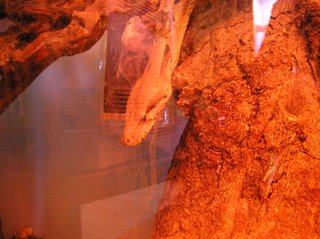
Woke up next to a boa constrictor the next morning,

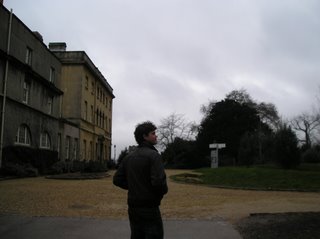
It, along with python, is the pet of Tim's housemate, and was thankfully still contained in its terrarium. Went out to get some brekky. Walked through the University of Bristol,

admiring the grandeur of their physics department - even grander than UWA's which mind you is the tallest building on the campus and a fine example of concrete nouveau.

Had a lookee at the Red Lodge, which i'm told is where Queen Elizabeth used to stay when she visited Bristol. It was built in 16c and has been variously renovated and modified since.

The south-facing, walled garden exemplifies a re-creation of an Elizabethan-style knot garden with herbaceous borders, circa 1630.

The house had been used for charitable purposes in the Victorian era,

which provoked us to reflect on how many young girls we ourselves had rescued from sin and misery, and brought back to the paths of holiness. Not many.

Walked south, around the town centre,

and crossed the river,

on our way to the British Empire and Commonwealth Museum.


A fine display of the historical, political, economic and cultural aspects of Britain's hegemony over most of the world. Still as post-colonial reverse migrants, these issues are close to home.
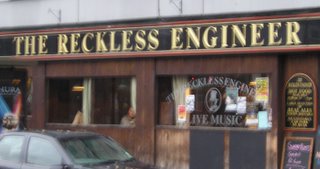
One of the rooms, allegedly the work of the great Brunel, was somewhat less inspiring than the Clifton Suspension Bridge.Had a few pints at The Reckless Engineer, apparently yet another celebratory allusion to Brunel, Bristol's favourite (adopted, he was born in Portsmouth) son,
then bade Tim, Bristol's second favourite adopted son, farewell,

and at 6:15 began the mission home, which finally ended at about 12:45, coinciding nicely with my sobering up. The monotony of transit was ameliorated by further reflections on the British empire theme courtesy of Niall Ferguson's fine book "Empire". Top trip.

Wednesday, February 01, 2006

Back in Britain

The Big Trip concluded for me, though Maarinke continued her Really Big Trip, with safe arrival back at Stansted and return to Cambridge. My box of posters, however, continued their train trip to Birmingham, where they dematerialised - I am an idiot and the train lost property services are not worth the paper their number was dutifully copied onto during my futile efforts to regain the posters. The Evil Train to Birmingham, from whose clutches I had narrowly escaped on my outward journey, finally got its revenge.

Maarinke spent a couple of days in Cambridge, where i introduced her to the joys of drinking warm ale, curry houses and the hallowed inner sanctum of the Pembroke graduate parlour, before venturing further north, leaving me to make a start on the year's work at the office.

Still all amped up about art and travel and stuff, i went to London that Saturday to catch the last day of the Derain exhibition at the Courtald Institute. First stop, though, was Lincoln's Inn Fields,

site of the Sir John Soane's Museum,

That is a real gem, definitely worth visiting if you're in London. John Soane was Professor of Architecture at the Royal Academy and architect of the Bank of England, Number 10 Downing Street and the Dulwich College Art Gallery, and is now regarded as a progressive and influential architect in the context of the neoclassical style. His house, which is packed to the rafters with antiquities and artifacts, paintings (esp. Hogarth's 'Rake's Progress') and Soane's own architectural and furniture designs, was opened as a museum during his lifetime and has been maintained in that state since. It rocks.

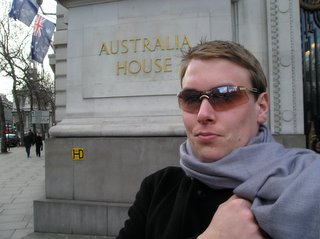
Moseyed south toward the Strand, pausing for a patriotic moment outside Australia House,

then, blinking back appropriately patriotic tears and humming "I still call Australia home", on to Somerset House, where an ice-rink has been set-up,

I wasn't there for frivolities like ice-skating so i marched purposefully into the Courtald Collection, flashed my academic staff member card: free entry - yes!!! (consolation for my choice to pursue the ascetic, almost monastic lifestyle of the academic) and charged in to see the Derain exhibition. Comprised of his paintings of London from 1906, when his Fauvish tendencies were in full effect, it provided an interesting counterpoint to the, probably more famous, London paintings of Monet.

It was real good. Also good to check out the collection there of Kandinskys, Jawlenskys, Mackes and Munters, given i had become a (self-proclaimed) expert in Expressionism whilst in Germany.

Went over to the Hermitage Rooms to have a look at an exhibition of watercolours entitled Gainsborough to Turner: British Watercolours from the Spooner Collection. That was very good also, and allowed me to reminisce on my recent tour:

This is Turner's painting of Drachanfels - remember that from my last post? It was the mountain next to the Rhine near Bonn where the dragon lived, the one that Siegfried (remember him? that's right, he was the hero of the Nibelunglied, on which Wagner's Ring Cycle was based, good, you were paying attention) slayed.

This is Cozens' picture of Castel Sant Angelo in Rome, which we saw when we were there. Naturally, i loudly pointed out to most of the other people in the room that "yeah, i've just been in Rome actually and seen that, yeah, just this month, looks even better in real life, went to Munich as well actually, and Florence." They applauded dutifully.

Went outside to get comparison of real Thames and surrounds with Derain's efforts.

Yep, London, if not looking quite like Derain's paintings, was looking good. It's a shame this shot was ruined by an idiot getting in the way just as the camera went off.

Still full of enthusiasm, i went to the Gilbert Collection to have a look at some Russian Avant-Garde photography,

a recent montage of Yorkshire landscapes by David Hockney

and some micromosaics.

A diverse selection indeed. Met Kylie and Anthony at Covent Garden and had a bit of high tea at the third oldest fish and chip shop in London, followed by a few beers then headed back to Cam and my aforementioned monastic existence there.

Met Maarinke in London the following week (what she did in the mean time shall remain a mystery until she starts her own blog), for her final day in England. Having sustained ourselves with pasties, we strolled from Waterloo down the Thames

to Tate Britain,

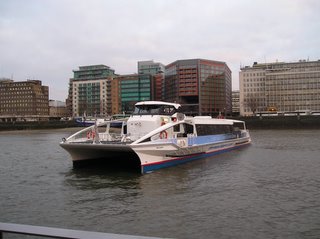
had a look there at the Pre-Raphaelites et al, then caught the Tate Boat,

(We were pretty excited)

all the way to Tate Modern, to have a quick look at Rousseau and some of the recently recurated main collection.

Dinner with Kylie & Anthony and MJ & Kieran in Clapham, then beddybyes. Saw Maarinke off the following day, after an heroic but unsuccessful attempt to consume a celebratory Australia Day beer with M's friend Joel (thanks a lot Walkabout Covent Garden, you pricks, for the false advertising regarding opening times), then scampered back to Cambridge to teach dynamics to second years (having taught it to myself on the train). After six weeks and seven countries, Maarinke returned to beautiful, sunny, summery, warm Sydney and i stayed here in the rain. I remain ambivalent on the virtues of sacrificing climate for career.

The Big Trip
Part 4: Bonn

Maarinke's aunt & uncle met us at Bonn/Cologne (French for good smell? - thanks for the gag, Dad) airport and the final leg of our tour commenced. Through a most fortuitous set of circumstances, our accomodation was slightly more upmarket than the backpackers hostels to which we had become accustomed, starting with the view from the window over the Rhine.

We strolled from Lis and Joachim's house around the centre of Bonn. It was the capital of West Germany until reunification. While the parliament moved to Berlin almost straight away, many of the ministry offices have remained in Bonn and there has been significant private sector investment so that, rather than decline into something of a ghost town as could have occured, it has remained a bustling city. Before becoming the West German capital, it was a relatively prosperous town that at one stage was the capital of the principality of Cologne. It has a big, prestigious university and was, amongst other things, the birthplace of Beethoven.

He is celebrated with a statue in the town square,

and his house is now a museum,

Preparations were already afoot for the annual Carnival, a traditional celebration over the lent period, which apparently involves liberal use of amusing costumes.

We were introduced to Bonnsch beer, consumed in much smaller glasses than in Bavaria - so that the beer doesn't warm up before one finishes drinking it, and cuisine - hearty, meat-dominated, best appreciated after at least 8 of the aforementioned Bonnsch beer.
________________________________________________________________

The next day, we travelled south along the Rhine, to see castles and vineyards and cliffs.
My previous experience of the Rhineland, a train ride from Cologne to Frankfurt in 2004, had been severely hampered by the aftereffects of an over-ambitious beer tasting session (52 beers tasted) on the last night of a conference in Leuven, Belgium, so i was looking forward to the twin benefits of a functioning brain and expert local guides. We drove south from North Rhine-Westphalia to Rhineland-Palatinate, crossed the Moselle at Koblenz, then stopped off in Bacharach to have a look at the coolest youth hostel I've ever seen, the Jugendherberge Stahleck, which is a castle on the edge of the cliff.


The view was amazing, though with windchill factor it was probably about 10 below, well outside my comfort zone.

Reaching Bingen, we crossed the river on a ferry on our way to see the Germania monument.

Heeding the warnings, the car was returned safely to terra firma.

Having fortified ourselves with hot chocolates and hefty servings of torte in Rudesheim, we headed up the hill, above the snowline,

to see Germania from close-up. Actually called the Niederwald Monument (of Germania, the symbol of German nationhood...), it was built in the 1870's to commemorate the unification of the German nation (cf. Vittorio Emmanuel monument in Roma) and as a bit of an up-yours to the French who had been soundly spanked in the Franco-Prussian war (Deutsch-Französischer Krieg), most of which was fought southwest of the site of the monument.

Whilst the monument is regarded as being a bit anachronistic in a symbolic sense, it looks cool and the view is good.

Back down the hill,

we continued along the Rhine past the Lorelei, the treacherous rocks onto which sailors have been tempted for centuries by sirens, and made famous by Heine's poem.

...She combs with a comb that is golden, And sings a weird refrain; That steeps in a deadly enchantment The listener's ravished brain...

The Nibelung hoard (of Wagner's Ring Cycle fame) is also, according to legend, buried under there. On the topic of Nibelungs, Siegfried a hero of the Nibelungenlied, the 'German Iliad', was supposed to have slayed a dragon living in a mountain near Bonn, called Drachenfels, that we had driven past that morning.

Returning to Bonn, we exchanged castles, romantic monuments and historical tales for the trappings of a modern capital,

and a tasty dinner at Lis and Joachim's house


__________________________________________________________

A marked improvement in the weather the following morning enabled the view from the hotel room to be appreciated properly:

The aim for the day was for Maarinke to become acquainted with her Dutch roots with a quick trip to Holland. Driving west, a discernible flattening of the landscape was noted, in sharp contrast to the craggy cliffs of the previous day. The presence of windmills, albeit not so traditional, indicated that we were getting close.

Maarinke was pretty excited as we crossed the border into Holland,

entering the province of Limburg. Situated in the far south-east of the Netherlands, tucked between Belgium and Germany, it comprises about half of the original Duchy of Limbourg, which was split when Belgium seceded from the Kingdom of the Netherlands in 1830. Maastricht and surrounds chose to stay with the Dutch whereas the towns of Limbourg and Liege joined the Wallonian region of Belgium.

Maastricht, situated on the Meuse (Maas) River, is one of the oldest cities in the Netherlands, having been originally settled by the Romans, though it is more recently famous for the Maastricht treaty. Signed there in 1992, this led to the formation of the European Community and subsequently the European Union, and the introduction of the Euro and associated monetary policy.

We had a stroll around the streets and squares,

stopped off for some Dutch staples: coffee, white beer, cake (Limburgse vlaai, I think...) and krokets. Mmm, unidentified & fried.

The Van der Meulens were able to live up to their name (From the Mill):

We wandered a bit more around the town, having a look at the Vrijthof,

and the Basilica of St Servatius,

Crossed the Maas,

and had a look down towards the buildings where the treaty was signed:

Downed a couple of authentic Dutch beers in De Bobbel,

and bade Holland farewell.

Back in Germany, we stopped off in Aachen (see map above) which was the seat of the Holy Roman Empire under Charlemagne aka Carolus Magnus, the founding father of both France and Germany and ancestor of all the royal families in Europe.

The cathedral was initially built by him (this octagonal section),

and in fact contains his remains.

How appropriate that, after visiting the site of the treaty which led to the creation of the Euro and the European Union, we should be paying tribute to Charlemagne, the head of the first united European empire since the Romans, and arguably the Father of Europe. A big day for pan-Europeanism!

And a big day for cool gargoyles too.

What a fascinating and important corner of Europe. Within a few hundred kilometres radius, there are five countries, territory that has been variously ruled or occupied by the Romans, Celts, Carolingians, Burgundians, Habsburgs, both Spanish and Austrian, the French, Prussians, Germans and now, some might say, the Eurocrats in Brussels. The original seat of the Holy Roman Empire in Aachen, the European Parliament in Strasbourg, the European Commision in Brussels, the treaty of Maastricht, Luxembourg, the original capital of the European Coal and Steel Community and now location of the European Court of Justice and European Investment Bank, the European Central Bank in Frankfurt are all within an hour or two's drive. While the EU has expanded eastward (as well as other directions...) from it's original base, and forseeably will continue to do so, much of the administration and consequently power remains concentrated in this relatively small, traditionally prosperous region.

Heading back to Bonn, we gave the European food and culture a rest with dinner at a Mexican restaurant and called it a night, satisfied after having achieved my second quickest trip to a country, almost eclipsing my memorable 3.5 hour jog around Luxembourg in 04.

__________________________________________________________

The weather had regressed again but, undaunted, we set out to Cologne, just north of Bonn on the Rhine (see above map again). It was raining there also, a phenomenon that might presumably be termed Colognic irrigation. Boom boom.

First stop, the Museum Ludwig,

which contains an amazing collection of modern art, both German and international. In particular, the biggest private collection of Picasso paintings in the world was endowed to the museum.

In addition, there were large offerings of Russian modernists,

German expressionists,

and American pop-art.

Here we are outside the Romisch-Germanisches Museum - the Roman's were apparently kind enough to leave enough ruins and artifacts in and around Colonia Agrippinensis, a colony in Germania Inferior settled under "agreement" with the resident barbarians, the Ubii, and in fact the northernmost Roman settlement, that an entire museum can be devoted to this today.

It must be admitted that Roman history was passed up in favour of Phase II of Lunch. It was deemed that baguettes and lattes at the Ludwig museum were not enough for us to grow up into big men, so we needed some further sustenance, in the form of Kolsch beer and meat, hearty quantities of both.

This is the guy in charge of filling up the beer glasses, a noble calling in deed.

Here is the meat. A local delicacy we were assured.

Maarinke could not be persuaded to compromise her vegetarianism (again), even in the name of authentic experience, so i had no choice but to give it a go.

Not bad, though i don't think i'll be trying to make it for myself at home. Especially given that home is in the land of mad cow disease. Subsequent meat was somewhat more cooked, and just as good:

Properly fed now, we were prepared to visit Cologne Cathedral, the largest (and on that day, one of the coldest) Gothic church in northern Europe and, in the 1880s, the world's tallest structure.

These boxes, the Sarcophagi of the Magi, allegedly contain the remains of the three wise men.

Frederick Barbarossa, a descendant of Charlemagne, flogged them, in the grand northern tradition of looting the cultural treasures of southern Europe (Elgin marbles, Pergamon, etc), from Milan. Presumably he was allowed by the Archbishop of Cologne to feel absolved of his transgression, having donated them to the cathedral.

Returning to Bonn, we headed along to Kunst Museum Bonn. Having been the capital, Bonn is notably endowed with museums. The collections in the Kunstmuseum originated earlier than that and are very strong in local works, those of Macke, a Bonn resident, and the other Rhenish Expressionists,

and Joseph Beuys, who hailed from Dusseldorf.

Lis and Joe were kind enough to take us out for an excellent final night dinner at their favourite Italian restaurant:

A fabulous meal, endowed in both quality and quantity, of which a notable highlight was the grappa dessert, berry sorbet with about half a litre of grappa poured over the top. Jollity ensued from all quarters.

_______________________________________________________________

Our final morning, and time for little else than farewells in Cologne (note grand and iconic cathedral in background),

Off, through snowy forests and fields,

to Hahn airport

and back to Old Blighty.

What a fantastic conclusion to our Eurotour! Four days in and around the Rhineland, four cities in two countries, too much food over at least five culinary traditions, innumerable museums, churches, monuments, sights and delights. Lis and Joachim were wonderful & generous hosts, showing us an excellent time, for which we were most grateful.

The Big Trip
Part 3: München

Exchanging pizza, chianti and relative warmth (>0ºC) for schweinshax'n, pilsener and freezingness, we alighted at Munich Flughafen & trained past snow-covered fields in to town.

Walked from our hostel (Wombat Hostel - really good and value => recommended), near the Hauptbahnhof, into the town centre and had a look around. Dined at Nordsee at the Viktualienmarket, after an entree of Schwarzwaldtorte-style doughnut (yes, it is as good as it sounds, cherries, cream, chocolate sprinkles - Krispy Kreme eat your heart out).

Had an obligatory beer at the Hofbrauhaus,

and called it a night at a relatively early hour in preparation for the forthcoming cultural blitzkrieg.

_____________________________________________________________
The following morning we strolled north to the area of town where most of the museums are located. Being the centre of the relatively prosperous and powerful Kingdom of Bavaria until the unification of Germany, Munich has some of the trappings of a capital: impressive large buildings laid out nicely amongst big gardens & open spaces.

Here we are in front of the Glypothek (sculpture museum):

which we admired from outside only, before heading to the Staatsgalerie im Lenbachhaus:

The highlights here were the works of Der Blaue Reiter: Kandinsky, Munter, Jawlensky, Marc, Macke et al, who lived and worked in Munich and surrounding towns in the early 1900s, and who did amazing things firstly with colour, and later with form.

The Munchener symbolist, Franz von Stuck, was pretty cool too (if a bit naughty... tee hee):

Walked east to the Englischergarten, so named after Sir Benjamin Thompson, aka Count Rumford, the American-born British-aligned (during the American revolution) thermodynamicist and emissary to the Elector of Bavaria, who laid out the plans for them.

Headed into town for a lunch of Bismarck herring sandwiches and giant pickled gherkins (one of the few vegetables available in Germany),

checked out the Rathaus by day,

then off to the Alte Pinakothek, for a hearty dose of meisterwerke europäischer malerei vom 14 bis 18 jahrhundert.

We were a bit time constrained but managed to zip through most of the galleries, checking out the masses of Cranachs, Holbeins, Memlings, Durers - lots of northern renaissance art to complement that from south of the alps we'd enjoyed in Italia. The big highlight was definitely the collection of Rubens, including the whoppingest painting of his that i've ever seen: the Great Last Judgement (about 6 metres tall, the jpeg here doesn't do it justice.)

Booted out at closing, but artistically unsated, we marched purposefully across the road, impervious to the bitter cold,

to the Pinakothek der Moderne, where after a rejuvanatory round of Ein caffe bitte,

we had a lookee at the amazing collection of modern art ranging from sculpture & paintings (Die Brucke & Der Blaue Reiter), to craft & design, to installations & video works.

Of particular note, there was a really cool video collage of the movies of Italian film-maker Piero Paolo Pasolini. One sat in the centre of the room and segments of the films were projected onto 16 screens around the walls. Parallel scenes from different movies were shown together, eg. a woman walking along a street, people starting to hold hands, people dancing etc. At other times, the scenes differed but complemented one another despite obviously being from different movies. At times there were up to 8 different scenes at once - it was redolent of Baraka or Koyanoqaatsi in the cacophony of images, but a spectacular illustration of how he returned to the same basic themes and employed consistent images throughout his career - it would have been pretty fun to produce the collage.

All this art had given us mighty big appetites, appetites so large they could only be quelled with half a pig. We returned to the Hofbrauhaus, having partaken of their libational but not culinary offerings the previous night, and got stuck right in:

The childlike joy in my face masks the screams of protest from my arteries (and liver, though it should have learnt by now that its ) as I tucked into the mighty piece-o-pig they call a schweinshax'n. Another opportunity to be embarrassed about our nationality as the oom-pah band played Waltzing Matilda and half the crowd (most of whom had ridden in to town on Kontiki buses methinks) went wild. A far cry from the dignified near-silence of the Alte Pinakothek but I suppose travel is flavoured by such contrasts.
____________________________________________________________

The next morning we headed north once again,

to complete the Pinakothek hattrick, going this time to the Neue Pinakothek to see paintings, predominantly German and predominantly from the 19th century.

Highlights were: paintings by the Nazarenes, pious Germans who lived in Rome and aimed to emulate the styles of the pre- and early renaissance masters (quite similar in ideology and style to England's own Pre-Raphaelite brotherhood),

paintings by Klenze and Schinkel, both better known for their neoclassical architecture, Klenze having designed the Glyptothek and Walhalla and Schinkel having designed the Altes Nationalgalerie in Berlin,

lavish sculptures by Canova and Thorvaldsen;

and a bit more Franz von Stuck (another risque theme, this one entitled Sin).

The paths around the town were covered with snow and ice which, on the oft-trodden ones, was quite smooth and hard. Most fortuitously my shoes had nice, flat soles which allowed me, by taking a bit of a run-up, to "skate" along for several metres at a time (trust me i measured it). I found that bending the knees slightly and shouting "Woo-Hoo" gave the best results.

Boy, that game never got tired. Miraculously, i didn't fall over. No photos i'm afraid as Maarinke declined to encourage such activities. The novelty of snow has definitely not worn off - 21 formative years in Western Australia has ensured that.

After a quick lunch at the Hbf, we caught the train out to Dachau for some history. It must be strange for the people in Dachau, which is a reasonable sized town half an hour's train ride from Munich, to know that their hometown is immediately associated with some of the worst atrocities of the second world war, thanks to the decision to build the first concentration camp there in 1933. The museum is set out really well, giving a lot of info on the social, economic & political background to WWII then portraying the inmates & the appalling conditions in which they lived, worked and in many cases died.

A large fraction of the prisoners at Dachau between 1933 and 1945 were ethnic Germans, predominantly political prisoners, dissidents who had opposed the Nazi regime as it came to power in the 1930s, in addition to the Jewish, Roma, homosexual and other prisoners regarded as impure under the xenophobic policies of the Nazis.

I can't say much more except that it was really worth visiting - a solemn reminder that a society as advanced as any other in the world at the time can produce such horrors.

An interesting counterpoint to the former concentration camp at Dachau was provided by a visit to Haus der Kunst, built under Hitler as a museum to display and distinguish between art approved by the Nazis and that condemned by them.

The approved stuff was a strange mix of strong images & sculptures (& buildings) and bucolic idealisations of German life, along with xenophobic depictions of the soon-to-be victims of the Holocaust. "We shall discover and encourage the artists who are able to impress upon the State of the German people the cultural stamp of the Germanic race . . . in their origin and in the picture which they present they are the expressions of the soul and the ideals of the community." (Hitler, Party Day speech, 1935). There are big similarities between the german Reich Kunst and the Socialist Realism promoted by Stalin around the same time.

The Degenerate Art condemned by them, and removed en masse from German museums, included Chagall, Beckmann, Ernst, Kandinsky, Kirchner, Klee, Mondriaan et al - basically a Who's Who of the most progressive, important and respected (now, at least) artists of the period, many of whom were German or lived in Germany. The Nazis staged exhibitions of selected "Entartete Kunst", the first of which was at the Haus der Kunst. Interestingly, over 3 million people attended these - it is hard to know what this says about the German people at the time.

One could dismiss the condemnation and ridiculing of paintings in comparison with the obvious human tragedy associated with somewhere like Dachau, but one is reminded that these were both facets of the same totalitarian regime - poignant in considering issues of censorship, freedom of speech, etc. While we can look back and scoff at the art that was 'approved', knowing that the 'degenerate' stuff was and is much better, the control of art by the state, while intellectually backward, reflected and propagated underlying political ideology that led to millions of deaths.

The building has an obvious sternness to it, in keeping with Hitler's imposing architectural ideals - art and architecture as tools for propagating ideology and gaining power and social control. The Haus der Kunst obviously isn't being used as a political tool now (except, subtly, in the sense that its very existence and its current use, exhibiting works that would no doubt have been regarded as degenerate, makes a statement), and I saw two very cool exhibitions, a retrospective of the photographs of Lee Friedlander and a collection of works by siblings in art, ranging from the Brothers Limbourg to Jake and Dinos Chapman.

We dined at Cafe Mozart, a really funky, ostensibly-Austrian (a biiiig schnitzel for the big fatty that i'm rapidly becoming) but quite cosmopolitan restaurant (near Sendlinger Tor, for anyone that's interested). The DJ mixing jazz and soul was a welcome contrast to the tuba and accordion rendition of Waltzing Matilda of the previous night.

____________________________________________________________

Farewelling Munich after an incredible three days there, we tarried not, dashing Flughafen-ward to check in for Cologne.

My fears regarding the dubiousness of my chosen budget airline were allayed upon discovering that Munich, unlike Rome, is one of their hubs; not only was my flight not cancelled, there were actually staff from the airline there to check me in, rather than some dodgy subcontracted checking-in service, so it was all good. Bade Maarinke a temporary farewell and made a dent in my travel reading: Millenium by Felipe Fernandez Armesto, a suitably lofty tome for our ambitiously self-improving expedition.

Final reflections on Munich: beyond the hearty Bavarian pretzels/beer/oompah/leiderhosen image that is initially presented to tourists, it is a really cool, stylish city. I enjoyed strolling the streets around the north of the town, near the museums and the opera, Residenz etc. - lots of trendy boutiques, little art galleries, stately buildings full of private banks and venture capital firms - signs of a prosperity that contradicts the much-vaunted economic stagnation in Germany - this is probably being experienced most drastically in the East. Munich definitely gives Berlin a run for its money as the cultural capital of Germany, I give it two thumbs up and definitely recommend it as a place to visit - though please, if you do so as part of a Kontiki tour, please do not go to the Hofbrauhaus, get drunk and sing along to the oompah band - it doesn't benefit anybody.

Next stop: Rhineland.